
How to Strengthen Innovation with Intrapreneurship
Intrapreneurs serve as the critical catalyst in global innovation – Louis Gump
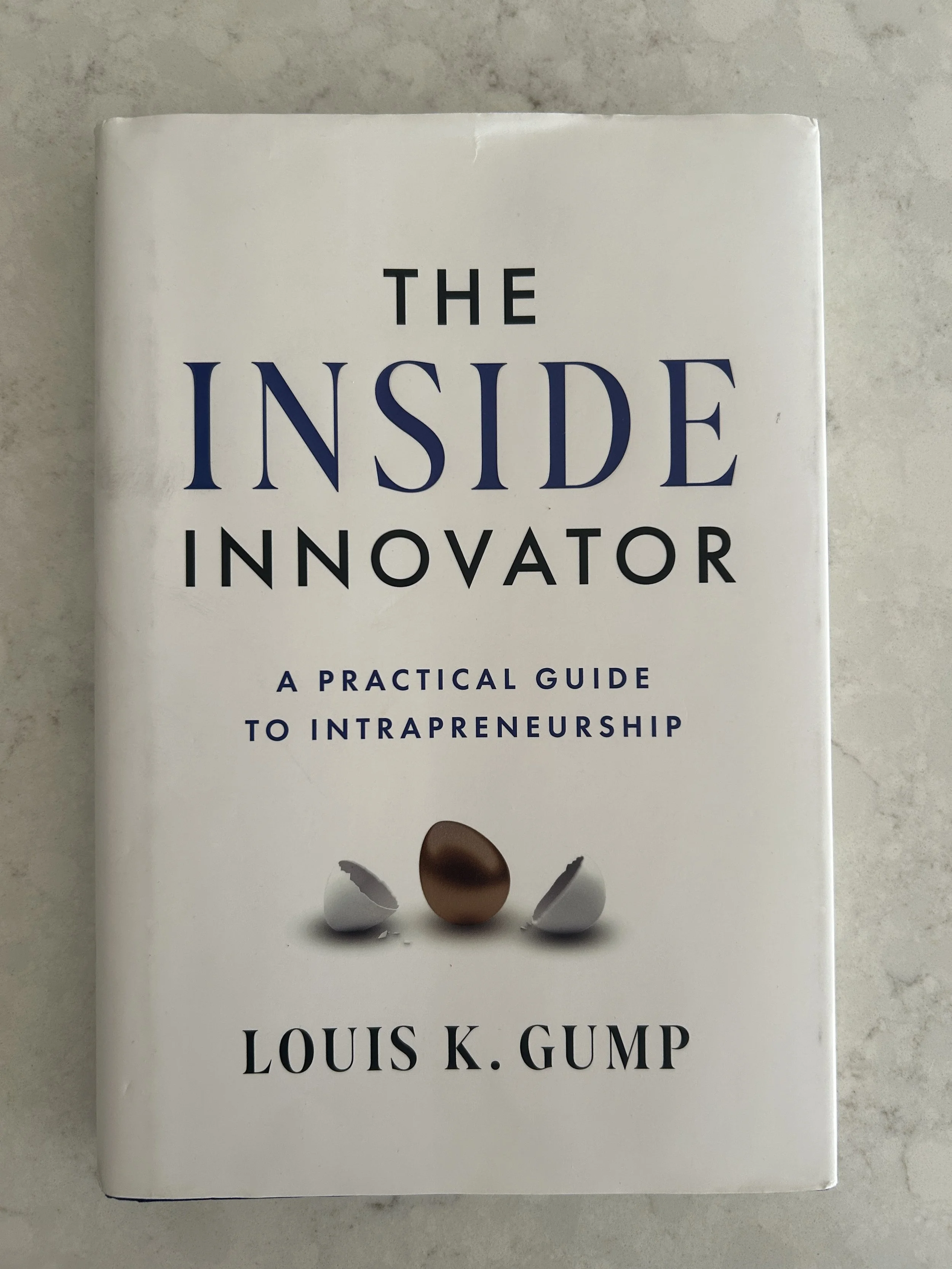
The Inside Innovator by Louis Gump
Have you heard of intrapreneurship before? I had not until I had the recent privilege of meeting Louis Gump, author of the Inside Innovator: A Practical Guide to Intrapreneurship. Intrapreneurs are internal, corporate innovators. If you work for a company and are involved with innovation, you are an intrapreneur.
Intrapreneurship is what enables mature organizations to remain innovative AND realize the value of innovation.
Louis has been a senior leader at several very large organizations such as Cox Communications, CNN, and the Weather Channel. He lives in metro Atlanta and we were introduced through a mutual acquaintance. Having led large R&D initiatives in the past and now being an entrepreneur myself, I appreciate the language and practical framework Louis provides to help organizations innovate.
He explains that the term originated back in 1978 from the husband-wife team, Gifford Pinchot III and Elizabeth Pinchot in a paper they wrote that was titled “Intra-corporate Entrepreneurship.” Gifford went on to write a book titled “Intrapreneuring” in 1985 and that same year TIME magazine published an article “Here Come the Intrapreneurs.”
The Challenges of Intrapreneurship and Innovation
Innovation is hard and typically the more established the organization, the harder innovation tends to be.
According to Louis intrapreneurship combines innovation with (1) entrepreneurship, (2) excellence, and (3) leadership. Understanding that intrapreneurship requires all four of these components is what made me realize why so many large organizations struggle with realizing the value of their innovation efforts. This includes the most recent surge in investments around artificial intelligence.
Leadership alone is not easy. Many organizations struggle to develop strong leadership pipelines. It requires emotional intelligence which does not come naturally to many brilliant, innovative, technically oriented individuals.
On top of that, entrepreneurship and excellence are required. There are some inherent paradoxes built into these that make it challenging unless your organization has developed paradoxical leadership skills.
· Entrepreneurship vs. Intrapreneurship
o Louis writes that entrepreneurs tend to be mavericks whereas intrapreneurs tend to be bridge builders and the best intrapreneurs are good connectors.
· Excellence is inherently a paradox of Quality x Acceptance, read my earlier blog that explains this.
A recent study from Frontiers on “Paradoxical Leadership: a meta-analytical review” (Lee et. al., 2023) concluded that paradoxical leaders had significant advantage over other leadership styles when it came to predicting innovation.
Another challenge is the stereotype of innovators as lone, excentric geniuses. In reality, bringing an innovation to market is a team effort and will fail without strong leadership and with the right team in place, even more innovative products or solutions can be developed.
How to Develop Intrapreneurship
1. Start with Your Inner Game
I found it interesting that “Start with Your Inner Game” was the title of Louis first chapter. He writes about knowing yourself, your stress tolerance, and the value of inner work – these are all related to self-awareness, which is the first step in building emotional intelligence. Emotional intelligence is the best predictor of success in life and leadership so it’s no surprise that it would show up in intrapreneurship too.
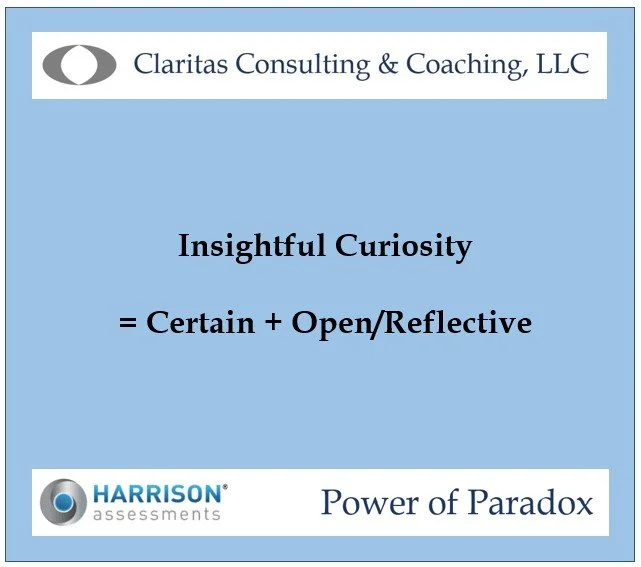
Harrison Assessments Insightful Curiosity Paradox
2. Look for people who are curious
One of the discoveries Louis made when he was writing the Inside Innovator was that curiosity was the single most consistent attribute that kept arising when people described effective intrapreneurs. If you have a new team or are bringing someone new into your team, contact Claritas Consulting & Coaching to go through Harrison Assessments. Insightful curiosity is one of the paradoxes that we can measure. Click this link to learn more about insightful curiosity.
3. Listen and Overcommunicate
From Louis’ experience, the biggest mistake an intrapreneur can make is being a poor listener. Here are a few things that can get in the way of listening:
· Stress – most people cannot listen well when triggered or under high stress. In certain situations, auditory exclusion can occur, which is why people may claim to never have heard what you know you told them.
· Bias – biases we may or may not be aware of can impact how well we listen to someone. If you don’t like somebody, this can reduce how well you listen to them!
As an intrapreneur, you are in sales – you are selling something new within your organization and to get the message across it is necessary to overcommunicate. Once you and your team are clear on what the next step is, plan for several weeks or months to get the rest of the organization on board. From my experience I have found that the larger the organization, the more time and effort this takes. This is necessary in order to build Acceptance because without sufficient Acceptance you will never achieve Excellence no matter how good the Quality is of your innovation.
If you are a leader looking to strengthen emotional intelligence, innovation, or collaboration on your team, book a free discovery call with Claritas Consulting & Coaching. We will be glad to discuss your challenges and brainstorm potential solutions.
If you found this useful, please share this article with others.