
When: the Question that Unlocks the Power of Paradox
Every leader has a version of this story. You gave someone the benefit of the doubt, and it cost the team a deadline. Or you held the line, and it cost you the relationship.
Looking back, you weren’t wrong to be supportive, and you weren’t wrong to be firm. You were just leaning the wrong way at the wrong time.
What if the question that could have changed the outcome was only one word long? The word is when.
Frank OR diplomatic. Change OR continuity. Accountability OR support. If you’ve been following my blogs on paradoxical leadership, you already know the answer to these tensions is AND. But knowing that is one thing. Acting on it on a Monday morning, with a deadline coming and a difficult conversation on your calendar, is another.
“When” is how you start.
The Case for Paradoxical Leadership
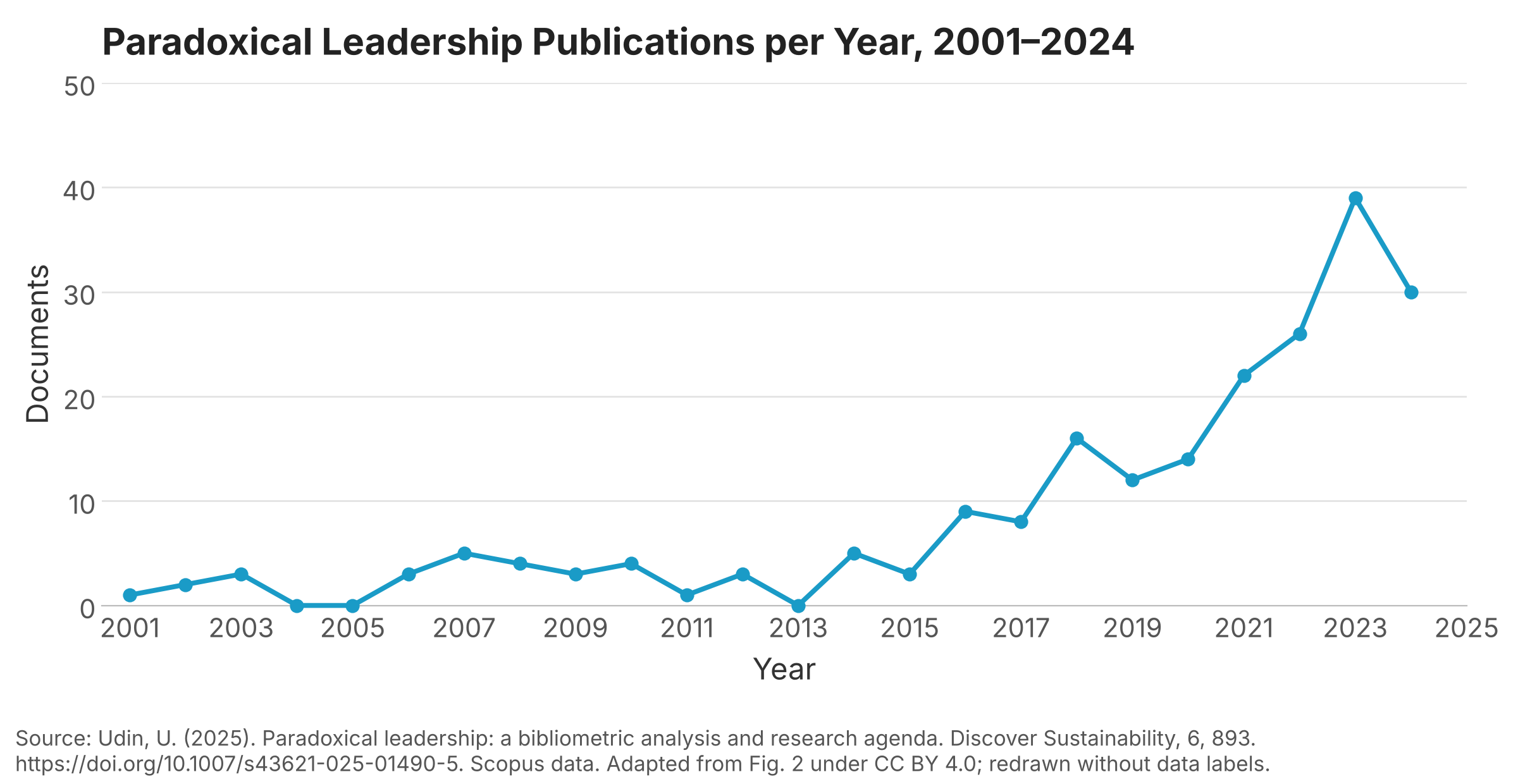
My theory is that most leadership frameworks weren’t built for the complexity of a post-COVID world. Paradox isn’t a new idea. What is new is how much attention it’s getting. A 2025 bibliometric analysis by Dr. Udin tracked paradoxical leadership research published from 2001 to 2024. Before 2020, fewer than 20 studies came out in any given year. Then the numbers climbed, from 12 in 2019 to 39 in 2023, more than three times as many in just four years.
Over several articles, I’ve been building the case for paradoxical leadership.
· In How to Cultivate the Power of AND, we looked at why our minds default to OR. We crave simplicity and certainty, especially under pressure. The bigger and more complex the issue is, the more important it becomes to shift to an AND mindset.
· In Paradoxical Leadership, we defined paradoxical leadership as a leader’s ability to adopt an AND mindset instead of an EITHER/OR mindset, and to flex their behavior based on the situation at hand. Situational Leadership® is a familiar example: a good manager knows how to direct AND support.
· And in The Power of Paradox: Paradoxical Leadership Comes of Age, we walked through Dr. Dan Harrison’s twelve paradox pairs and what I call the Paradox Principle:
An unresolved paradox is a source of tension and conflict.
A well-managed paradox generates alignment and forward momentum.
Two researchers have done more than most to give us language for this: Dr. Marianne Lewis and Dr. Wendy Smith. Early in her career, Lewis was discouraged by her advisors from choosing paradox as her dissertation topic. Decades later, her and Smith’s work on paradox theory received the Academy of Management Review’s 2021 Decade Award, and their book Both/And Thinking was named to the Thinkers50 Best New Management Books list in 2023. Their term, both/and thinking, captures what paradoxical leaders do: move beyond either/or choices and work from a bigger box that holds both sides.
Is being able to manage paradoxes worth the effort? The research says yes, especially when innovation is on the line.
In the first meta-analysis of paradoxical leadership behavior, Allan Lee and colleagues (Frontiers in Organizational Psychology, 2023) combined 65 studies from 55 articles. Paradoxical leadership was consistently linked to stronger follower performance, creativity, voice, and innovation, and the link to innovation was the strongest of all. Even after accounting for transformational, transactional, and servant leadership, paradoxical leadership still explained between 25-75% of the explained variation in follower innovation, depending on which style it was compared with.
Notice that even the research comes with a “when.” Paradoxical leadership stood out most when the goal was innovation. The authors also called for more research into why and when paradoxical leadership shows up. That second question is what this article is about.
The first step in managing a paradox is spotting it. But once you start seeing paradoxes everywhere, a practical question follows: now what do I do with them?
When is the Thread Running Through Paradoxical Leadership
Look back at each of those articles and you’ll notice the same idea showing up again and again: the situation.
Situational Leadership® asks a leader to adjust how directive or supportive they are depending on the person and the task. The Power of AND acknowledged that there is a time and place for OR thinking, such as A/B testing. And the Harrison Assessments Paradox report shows that when someone is strong in both traits of a pair, it becomes easier to flex toward one or the other as needed.
Paradoxical leaders aren’t frank AND diplomatic in equal measure every minute of the day. They know when to lean toward candor and when to lean toward tact, and they can do both well.
That’s where the power of “when” comes in. Asking “Which one is right?” forces a choice. Asking “When is each one right?” keeps both on the table.
“When” is both/and thinking in disguise.
In this article, we’ll look at how to use that one question to start engaging with paradox in your everyday leadership, with your team, and in your own development.
How to Put “When” to Work
Here are three ways to start using the question, each one a step further than the last.
1. Ask “when” about yourself
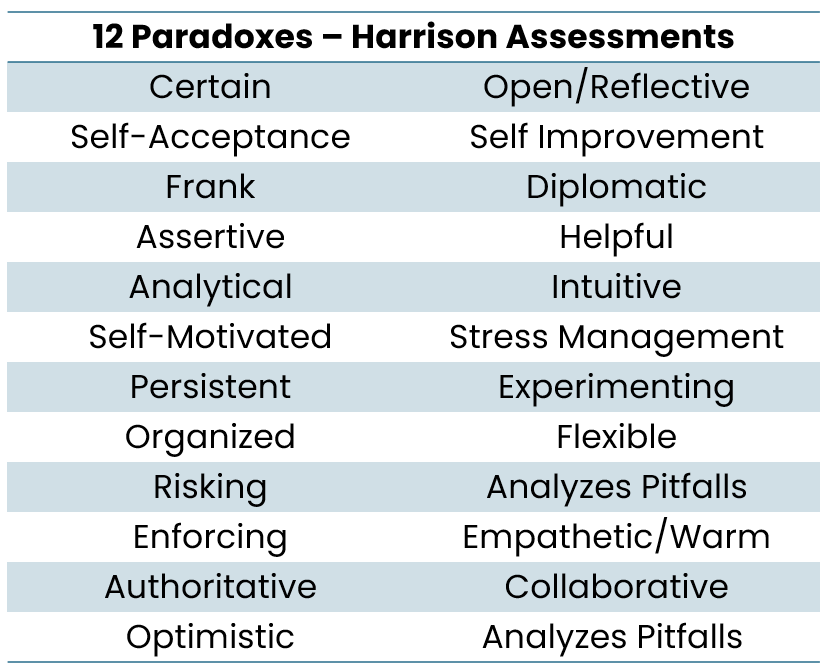
Start with the paradox pair you find hardest. If you are familiar with Harrison Assessments’ Paradox report, this is usually the pair with the largest gap between the two traits. If you haven’t, think about the feedback you hear most often, e.g., perhaps it is “You’re too blunt” or “I never know where I stand with you” if we look at the communication paradox. Being able to be both frank and diplomatic is what Dr. Harrison calls Respectful Candor.
Then take a blank page, draw a line down the middle, and finish two sentences:
“I need to lean toward ___ when…”
“I need to lean toward ___ when…”
Here’s what that might look like for respectful candor:
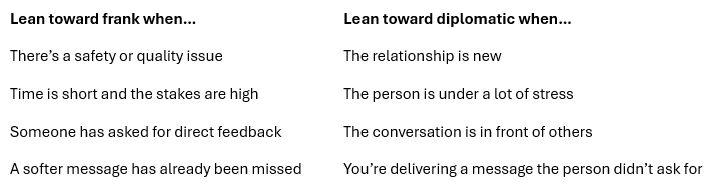
There’s no single right list. What matters is that you’ve taken a trait that felt like a fixed part of your personality and turned it into a choice you make deliberately. That’s a major shift. Behavior can be developed, and the “when” list becomes your guide for developing it.
Next, add a third column: “I know I’ve leaned too far when…” This is where a strength overused becomes visible. For a frank communicator, it might be “people stop bringing me problems.” For a diplomatic one, it might be “I have the same conversation three times and nothing changes.”
2. Ask “when” in the moment
Most of us don’t get to pause and fill out a table in the middle of a hard conversation. Under pressure, our brains switch to OR mode because it’s faster. So, the goal is a short question you can ask yourself in the moment:
“What does this situation call for right now?”
Let’s say Maria is an engineering manager. One of her senior engineers, David, has missed a design review deadline for the second time. Maria’s natural style is warm and supportive, so her first instinct is to ask whether he’s okay and offer to push the date back again.
Before she does, she asks herself the “when” question. A missed deadline once could be a one-off. A second missed deadline, with a downstream team waiting, calls for her to lean toward enforcing, without letting go of empathy. That’s the Harrison Assessments paradox of compassionate enforcing.
So instead of “No worries, let’s push it to next week,” she says:
“David, I want to check in on the design review. This is the second date we’ve missed, and the test team is blocked until it’s done. I’d like to understand what’s getting in the way, and I also need us to agree on a date we’re both confident in. What’s going on?”
She is still warm. She is also clear. The “when” question didn’t make her choose between the two. It told her which one to lead with.
3. Ask “when” with your team
This is where “when” becomes really powerful. Remember the paradox principle: an unresolved paradox is a source of tension and conflict. A lot of team conflict is two people arguing for opposite sides of the same paradox, each certain the other is wrong.
Picture a manufacturing team debating a process change. Half the team wants to update the procedure to fix a recurring defect. The other half wants to keep the current procedure because it’s validated and stable. Ask “Which is right?” and you have an OR debate with a winner and a loser.
Instead, try reframing it as a “when” question. A few phrases to try:
“I’m hearing two things that are both important: fixing this defect AND keeping a process we trust. When does it make sense to change the procedure, and when should we protect it?”
“What would need to be true for us to change it?”
“Let’s agree on the signals ahead of time, so we’re not having this same debate every time.”
The team may decide, for example, that a defect showing up across multiple shifts is enough to trigger a procedure review, while a single occurrence gets investigated first. Now the team has a shared rule for both change AND continuity. They’re no longer arguing positions; they’re agreeing on conditions.
Bonus Insight: Sometimes “when” is a matter of sequence rather than situation. In innovation, a team can lean toward risking and openness first and then lean toward analyzing pitfalls once it’s time to evaluate them. Both traits are fully present, just not at the same moment. Innovation is often stifled if one person is still brainstorming while another has already started critiquing.
Start with One “When” this Week
This week, pick the tension you feel most often, whether it’s frank AND diplomatic, supportive AND enforcing, or change AND continuity. Before your next meeting or difficult conversation, ask yourself:
“What does this situation call for right now?”
Afterward, take two minutes to reflect: Did I lean the right way? What signal told me which way to lean, and what signal did I miss?
That’s it. One question before, one question after. Over time, those small moments of reflection add up to a leader who knows when to lean which way, without giving up either side.
Remember the story we started with: the benefit of the doubt that cost a deadline, or the firm line that cost a relationship. Neither instinct was wrong. The missing piece was when.
Leadership is complex, but it does not have to be complicated. Sometimes the clearest path forward starts with a single word.
If you’d like to help your leaders or team build this skill, schedule a complimentary discovery call with Claritas®. Claritas Consulting & Coaching is proud to be a certified Harrison Assessments solutions provider. Our paradox workshops use the Harrison Assessments Paradox report to show leaders and teams where their natural tendencies lie, and when to flex, so they can navigate conflict, manage competing demands, and turn tension into forward momentum.
If you found this useful, please share this article with others, or subscribe below for more leadership and team development content.
This article was written by Gloriana Teh with assistance from Claude, an AI assistant by Anthropic. All ideas and frameworks, unless specifically noted, along with final edits are my own. All research has been verified against its original source.